How to Make Money Online with AI in 2026: 5 Proven Methods

TL;DR: In 2026 there are five realistic ways to make money online with artificial intelligence: AI OFM (AI OnlyFans Management), AI freelancing, AI automation for businesses, AI education, and AI content creation for clients. The fastest to scale is AI OFM — we made a documented $1,510.31 with it in the first 28 days, starting from zero. The table below shows each method's startup cost, time commitment and realistic income range side by side.
Why is 2026 the best year yet to make money online with AI?
Artificial intelligence has reached the point where a single person can create content, services or automations at a quality that used to take a whole team. An image that took a designer hours last year now takes minutes. A chatbot that used to need a developer can now be built with a no-code tool. That leverage is what lets a solo entrepreneur compete on a global level today.
At the same time, many niches still have few serious players — so if you start now, you're not up against 10,000 competitors, just a few dozen. In this article we walk through the 5 most realistic methods: for each one we cover what you need, how much time it takes, what income is realistic (marked as estimates), and how hard it is to get started. At the end you'll see everything in a single comparison table, and we'll show why AI OFM is the fastest route, using our own documented result. If you're more interested in how passive this kind of income really is and how the compound effect works, read our passive income with AI article.
1. AI OFM (AI OnlyFans Management) — creating and selling content
The core of AI OFM: you create content with an AI-generated model and sell it on a subscription platform such as Fanvue. Not your face, not your body: a consistent AI character that you control. This is exactly what we do — $1,510.31 in the first month, starting from zero. The AI OFM platform gives you the complete toolkit for it: 1995 ready-made prompts, the 17-step Fanvue Method and built-in AI image generation.
- What you need: an AI image generation tool, a consistent character, a Fanvue account and a proven workflow. The Starter plan gives you 15 SFW prompts for €0, so you can try it for free before paying anything. No coding required.
- Time commitment: 1–2 hours a day in the first few weeks for content creation and social media growth; after that, much of the system can be automated. That's 7–14 hours a week.
- Realistic income (estimate): our documented result was $1,510.31 in the first 28 days. As an industry estimate, $300–$2,000 a month in the first 3 months is realistic for someone who stays consistent — but there's no guarantee; the outcome depends on your persistence.
- Difficulty: medium. No coding, but you do have to learn and work consistently. You'll pick up the basics of image generation in a few days.
Good to know: Fanvue takes a 20% commission, so 80% of revenue is yours; payouts are in USD, from a $20 minimum, by bank transfer. We laid out the full launch process step by step in our AI OFM beginner's guide, and the basics of image generation in AI image generation for beginners.
2. AI freelancing — services powered by AI tools
Classic freelancing (photo editing, copywriting, translation, design) turbocharged with AI: you do the same work in a fraction of the time, so you can take on more in the same number of hours. The main platforms are Fiverr and Upwork, but you'll also find clients in Facebook groups and on LinkedIn. The trick isn't telling people you use AI — it's being faster and cheaper than the competition.
- What you need: confident command of one or two AI tools (image generation, writing, translation) and a portfolio with 3–5 sample projects. The accounts are free.
- Time commitment: 15–25 hours a week if you take it seriously — this is active work, not passive income. What you put in is what you earn.
- Realistic income (estimate): as an industry estimate, roughly $300–$800 a month as a beginner, and $1,000–$2,000+ with experience. Income scales linearly with time, though: if you don't work, you don't earn.
- Difficulty: low to medium. You can start quickly, but price competition on the platforms is fierce, and landing your first few orders without references is hard.
3. AI assistants and automation for businesses
Countless small and mid-sized businesses have no idea how to use AI — and you can set it up for them: a customer-service chatbot, email automation, content generation workflows, quote-request processing. This is a B2B service, so you can charge more than you would consumers, because you're saving the business time and payroll.
- What you need: knowledge of automation tools (chatbot platforms, no-code tools, API basics), business communication skills and 1–2 reference projects — even doing the first one for free so you have something to show.
- Time commitment: 10–40 hours per project, plus client acquisition. It typically takes 1–3 months to land the first paying client.
- Realistic income (estimate): as an industry estimate, roughly $400–$2,000+ per project, topped up with monthly maintenance retainers. Good income even with few clients, but sales is the bottleneck.
- Difficulty: high. You need technical skills AND sales skills at the same time — the highest barrier to entry of the five.
4. AI training and consulting
If you already have real, provable results in an AI field, you can teach it: as an online course, a workshop, one-on-one consulting or corporate training. There's strong demand for practical, not theoretical, AI know-how — people don't want more theory, they want a recipe that works.
- What you need: real, documented experience (don't start without it — the market quickly weeds out fake gurus), a teaching platform or community, and content that proves your expertise.
- Time commitment: building the course is 40–100 hours of one-off work; after that, sales and support take a few hours a week. This method becomes partly passive over time.
- Realistic income (estimate): as an industry estimate, roughly $300–$1,500 a month with a smaller but engaged audience. It depends heavily on trust and your reach.
- Difficulty: medium — but it only works if you've first achieved results with one of the other four methods. Experience is the entry ticket here.
5. AI content creation for social media clients
Brands and influencers are constantly hungry for content: short videos, images, carousels, copy. With AI you can produce it much faster than traditional creative agencies — and charge less while keeping a healthy margin. AI video generation for TikTok and Reels has become its own profession by 2026, with its own demand.
- What you need: knowledge of image and video generation tools, basic editing skills and a feel for platform trends. Your own content page that shows growth is enough of a portfolio.
- Time commitment: 5–10 hours a week per client, and you can run several clients in parallel. Production scales if you have a system.
- Realistic income (estimate): as an industry estimate, roughly $150–$500 a month per client on a flat retainer; with 3–4 clients, it adds up to meaningful monthly income.
- Difficulty: medium. Getting started is easy; consistently landing clients is the harder part. Our TikTok strategy for AI content article helps you build reach.
The 5 methods compared in one table
Here's the full picture at a glance. The income ranges are industry estimates, except for our own documented $1,510.31 result for AI OFM:
| Method | Startup cost | Weekly time | Realistic monthly income (estimate) | Difficulty | Income type |
|---|---|---|---|---|---|
| AI OFM | From €0 (Starter plan) | 7–14 hours | $300–$2,000 (ours: $1,510 in month 1) | Medium | Scalable / partly passive |
| AI freelancing | ~$0 | 15–25 hours | $300–$2,000+ | Low to medium | Active (time = money) |
| AI automation | Low | 10–20 hours | $400–$2,000+ / project | High | Project + retainer |
| AI training | ~$0 | 5–15 hours | $300–$1,500 | Medium | Partly passive |
| Content creation for clients | Low | 5–10 hours / client | $150–$500 / client | Medium | Active / retainer |
Why is AI OFM the fastest route?
The table makes the key point clear: freelancing and client work are active income — you sell your time, and if you don't work, you don't earn. AI OFM, on the other hand, builds an asset: an AI model and a subscriber base that keep earning even when you're not at your computer. We broke down exactly how that turns into passive income in our passive income with AI article.
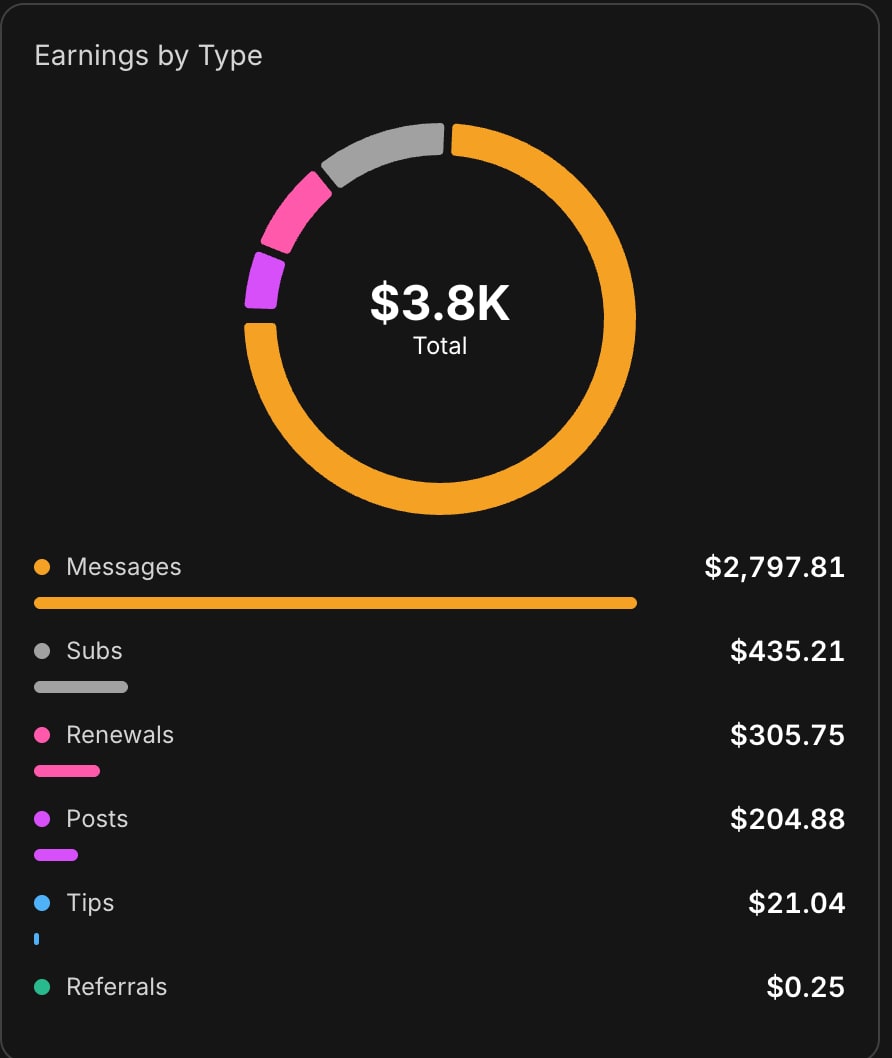
Here's what our documented first-month result looked like, in 28 days, starting from zero:
- $1,510.31 total revenue — of which $1,114.81 Messages/PPV, $184.88 Posts, $168.86 Subscriptions, $23.96 Renewals, $17.80 Tips
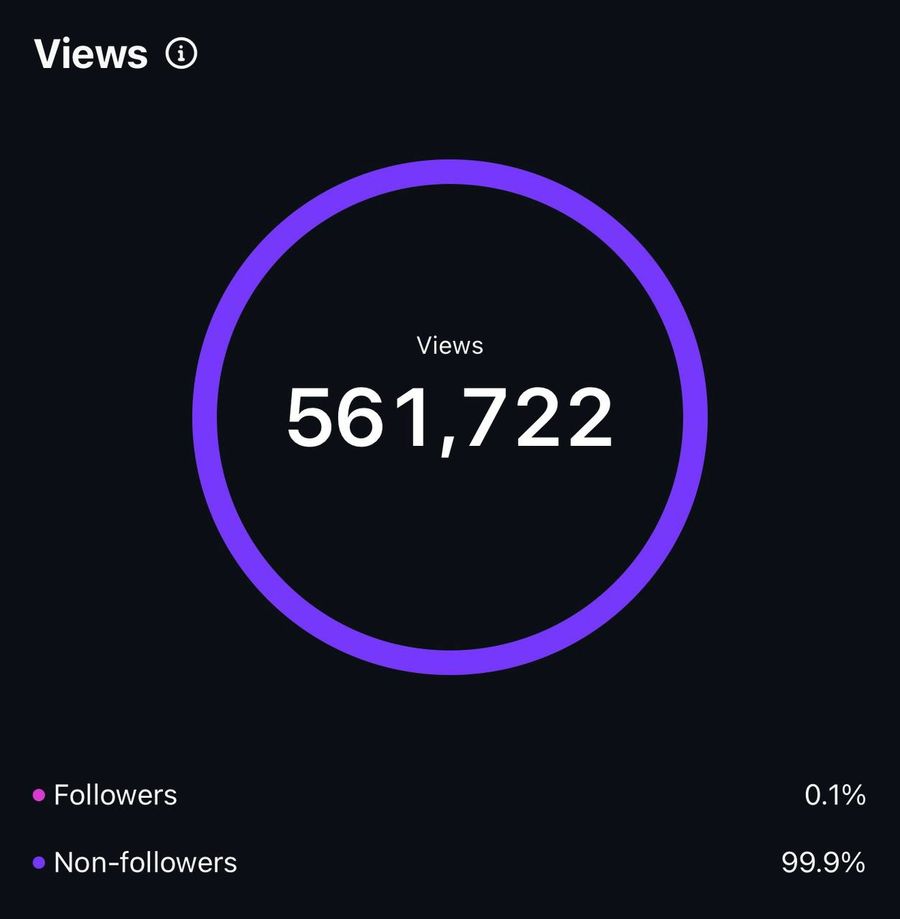
- 503,000 views, 19,000 profile views, 24,000 likes, 2,632 shares on social media
Two things stand out in these numbers. First, nearly 74% of revenue came from messages and PPV — so posting images isn't enough; communication is what brings in the money (that's what our PPV strategy article is about). Second, half a million views shows that the AI content market is far from saturated. We took a detailed look at where this market stands and where it's heading in our AI content creation in 2026 analysis.
The barrier to entry is also the lowest of the five. Here are the plans to choose from:
| Plan | Price | Prompts | Extras |
|---|---|---|---|
| Starter | €0 | 15 SFW | Free trial |
| Insider | €59/mo | 1200 (800 core + 400 premium) | Telegram VIP, warmup plans, video workflow, the first 4 lessons of the course |
| Mogul | €200 for the first 3 months, then €69/mo | All 1995 | Video workflow, video course, personal support |
So you don't have to sink a fortune into it before finding out whether it works for you. With the Starter plan you can try the whole thing for €0, and only move up once you see your own results.

What about taxes?
Whichever method you choose, the income is taxable. In most countries regular online income counts as self-employment or business income, and platforms like Fanvue pay out as a company (Fanvue Ltd), so you'll need to report it properly. Many countries also have registration or VAT/sales-tax thresholds — exactly how they apply to you is something your accountant can tell you. In every case, check your local rules with an accountant before you start; we summarized the legal background in our legal questions about AI content article.
How to get started today
The biggest mistake we've seen: researching for months, comparing tools, and never actually starting. Instead:
- Pick one method — one, not three in parallel. Based on the table, choose the one that fits your time and income goals.
- Give yourself 90 days of consistent work before you judge. The first month is always the hardest.
- Use a ready-made system — for AI OFM, our platform has 1995 ready-made prompts, 12 locations, 53 poses and the 17-step Fanvue Method waiting for you, and you can start with the free Starter plan.
- Ask the community — in our Telegram group of 387+ members you get real experience, not marketing.
AI on its own isn't a money-printing machine — but in 2026 it's the biggest leverage a solo entrepreneur can have. The only question is whether you use it.
Related articles
Frequently asked questions
Which AI money-making method is the fastest to start?+
AI freelancing and AI OFM are the fastest to start, because neither needs startup capital. Freelancing brings in money right away but stays active work. AI OFM scales better after a few weeks of ramp-up: we made $1,510.31 with it in the first 28 days, starting from zero, and much of the system can be automated after that.
How much money do you need to start AI OFM?+
You can start with practically nothing: the Starter plan is free and includes 15 SFW prompts, and signing up for Fanvue costs nothing. If you want to get serious, the Insider plan is €59/mo with 1200 prompts, the image upscaler and the video workflow. Fanvue takes a 20% commission, the remaining 80% is yours, and payouts start at $20 by bank transfer.
Do I need a registered business for online income from AI?+
Usually, yes — regular online income is taxable in practically every country, and it's typically reported as self-employment or business income. Fanvue pays out as a company, so the money needs to be declared properly. Many countries have registration and VAT or sales-tax thresholds too. Check the exact requirements where you live with an accountant before you start.
How much can you realistically earn with AI in 2026?+
It depends on the method and the work you put in. As an industry estimate, AI freelancing can bring in roughly $300-2,000 a month, and content creation for clients about $150-500 per client. In AI OFM, our documented result was $1,510.31 in the first month — a real data point showing what consistent work can achieve.
Now see what it's like for real
You've read it — now put it to work. These are ready and waiting on the platform.
Available on a free account — no credit card needed. Sign me up
Follow along on social: